
I’ve stood over my calatheas with a watering can more times than I’d like to admit, second-guessing myself.
Two of them sit on the same shelf. One wants water about every week. The other waits nearly two.
That’s when I stopped trusting calendars.
“Keep it consistently moist” sounds simple. It’s also how a lot of calatheas end up with soggy roots and crispy leaves at the same time.
What I trust now is a short soil check, cross-read against what university extension programs say about watering houseplants. Below is how I decide, day by day, and what to do when the leaves send mixed signals.
This guide is only about watering. Light and humidity show up only where they change when you should pour.
Quick answer
- Water when: the top 1–2 inches are dry and the soil below is still damp
- Typical range: every 5–10 days in spring and summer, every 7–14 days in fall and winter (a starting point, not a rule)
- Target: damp like a wrung-out sponge. Never soggy, never bone dry.
- Always: drainage holes, and an empty saucer afterward
How Often to Water a Calathea? Follow One Watering Through the Week
The honest answer isn’t a number. It’s a week.
Here’s what one watering looks like in my 6-inch pot, in a warm room with bright, indirect light.
| Day | What I see and feel | What I do |
|---|---|---|
| 0 | Water ran out the bottom. Pot is heavy, soil is dark. | Empty the saucer. Walk away. |
| 2–3 | Surface is lighter. An inch down is still damp. | Nothing. |
| 4–5 | Top inch is dry. Deeper soil is cool and slightly damp. | This is the window. Water in summer. In winter, give it another day or two. |
| 6–7 | Pot feels clearly lighter. | Water now. |
| 8+ | Leaves start to curl. | Too late. The roots have already had a rough stretch. |
That’s my summer rhythm. In fall and winter, the same pot stretches to 7–14 days.
Your pot won’t match mine. That’s the whole point.
The University of Maryland Extension says it plainly: plants should not be watered on a schedule, and potting mix, humidity and temperature all change how fast they dry.
Consistently Moist Is Not the Same as Wet
Think of a wrung-out sponge. Damp all the way through. Nothing drips.
The Missouri Botanical Garden’s profile for the zebra plant says to keep the soil moist but not wet during the growing season, and to reduce watering in winter as growth slows.
NC State’s profile of Goeppertia orbifolia (the newer botanical name for many calatheas) says the plant needs to be consistently moist but not wet or soggy.
See the word consistently?
In my experience, it’s the swing that does the damage. Bone dry one week, flooded the next.
The other side of that swing is waterlogging. University of Wisconsin–Madison Extension notes that root rot pathogens thrive in wet soils with poor aeration and drainage.
So when I’m unsure, I lean slightly dry. A thirsty calathea bounces back with one good drink. Soggy roots take much longer to recover, if they do.
The Two-Minute Check I Trust
I use three checks. I rarely need all three.
The finger test. Wisconsin Extension suggests going about one inch down. Maryland suggests about two inches.
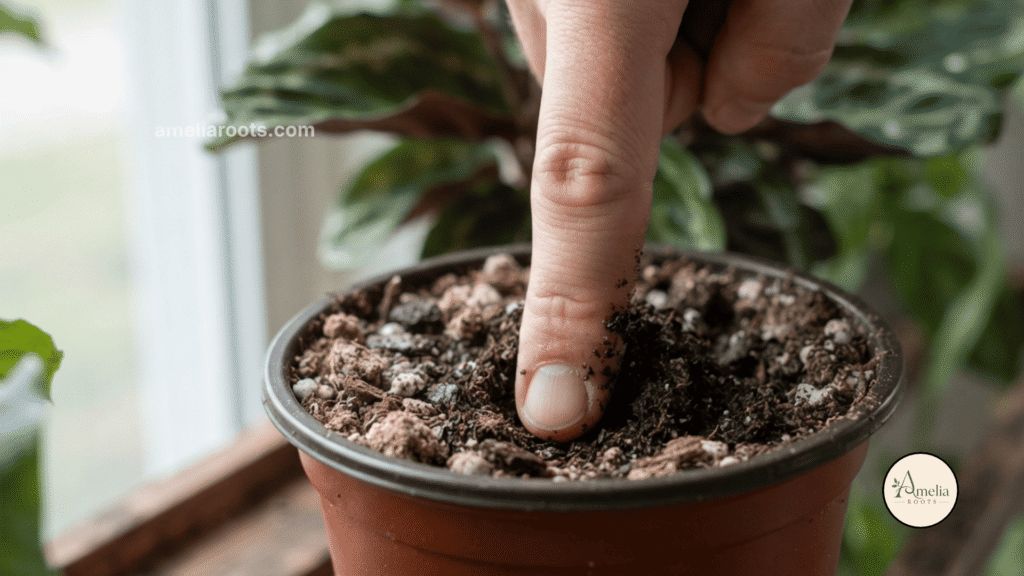
Both work. I use one inch in pots up to roughly 6 inches wide, and two inches in bigger ones.
Water if it’s dry at that depth and still damp below.
The weight check. Lift the pot right after watering and remember how it feels. When it’s clearly lighter, it’s ready.
If your calathea lives in a decorative pot, keep it in its nursery pot inside. You can lift it out and look at the roots.
The moisture meter, used carefully. With a new Ornata, my meter read “dry” and I almost started watering daily.
The probe was only sitting in the top layer, which dries first. Pushed down near the roots, it read damp.
One watering away from a mistake.
The winter trap: heating dries the surface fast while the roots stay damp. A dry top inch can lie in winter. I go deeper with my finger, or I lift the pot.
Most calathea owners aren’t bad at watering. They’re guessing.
Water on Tuesday. A curled leaf on Thursday. Panic by Friday.
The Indoor Plants Care Kit gives you something to check against, so the next curl doesn’t send you straight back to the watering can.
Grab the Indoor Plants Care Kit — it’s free.
How I Water, Step by Step
Thorough beats frequent. A few small sips only wet the surface and leave dry pockets underneath.
- Use room-temperature water.
- Pour slowly, in stages, so the mix can absorb it.
- Stop when water runs from the drainage holes.
- Let it drain, tilting the pot slightly.
- Empty the saucer after about 15 minutes.
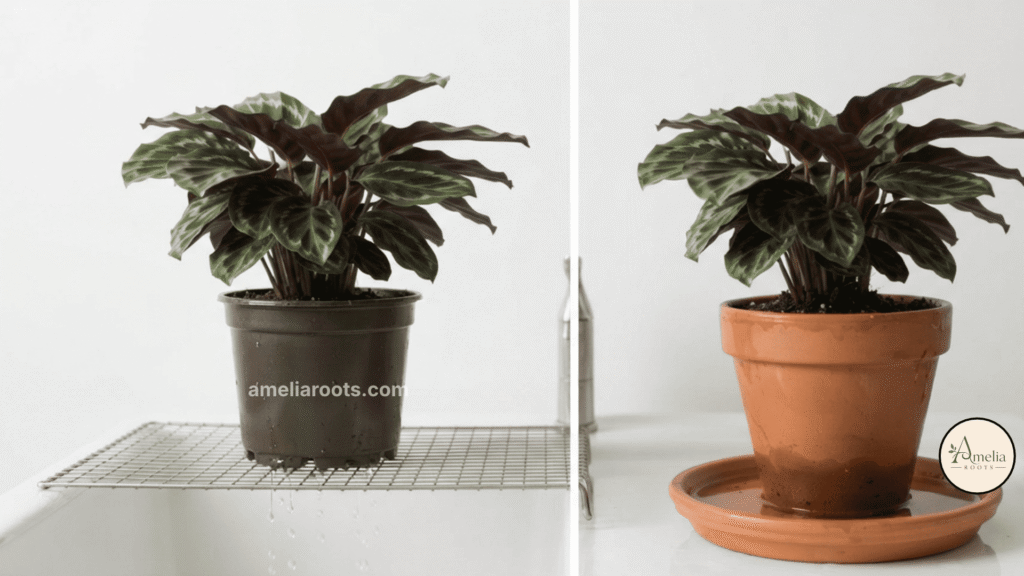
University of Missouri Extension is stricter than most people expect: no water should remain beneath the pot an hour after watering.
If the mix has shrunk away from the pot’s edge, water runs straight down the gap and misses the roots. In that case I bottom-water for 20–30 minutes, then drain it completely.
A small plant? A paper towel under the pot pulls away the last bit of excess.
Why Yours Won’t Drink on My Schedule
| Your situation | What changes | What I’d do |
|---|---|---|
| Heat on (radiators, forced air) | Surface dries fast, roots don’t | Check deeper or lift the pot |
| Summer AC | Mix dries sooner | Check a day or two earlier |
| Dry climate or dry apartment | Faster drying, crispier edges | Check more often, watch the leaf tips |
| Humid room, like a bathroom | Mix stays wet longer | Wait longer |
| Decorative pot, no drainage hole | Water hides at the bottom | Keep the nursery pot inside and drain it |
Change one thing at a time. Repotting, moving the plant and changing your routine all at once stresses a calathea more than any one of them alone.
Tap, Filtered or Distilled?
Calatheas are among the plants that notice what’s in your water.
Iowa State Extension says too much chlorine and other chemicals like fluoride can cause brown leaf tips, especially on sensitive plants like prayer plant and calathea.
NC State recommends distilled water or rainwater because of the fluoride in tap water.
Letting tap water sit overnight clears chlorine. It doesn’t remove fluoride, and chloramine, which some utilities use instead, doesn’t escape either.
Not sure what’s in yours? The EPA requires utilities to send an annual water quality report. It’s worth a look.
One more thing. After a water switch, the new leaves come in clean first. The old marked ones stay marked.
Read the Leaves Before You Reach for the Can
Overwatering and underwatering can look alike. Curling. Drooping. Yellowing. That’s why check-the-soil-first comes before everything else.
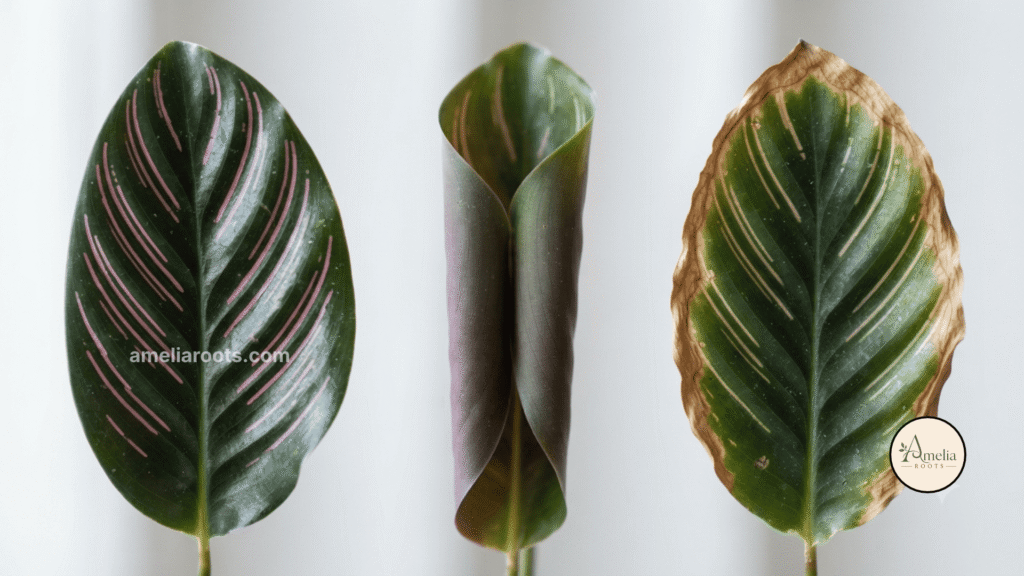
| What you see | Likely cause | Check first |
|---|---|---|
| Curling | Thirst or dry air | Soil, then humidity |
| Crispy brown edges | Dry air, minerals or water chemicals | Humidity and water type, not more water |
| Yellow leaves | Too much water or root stress | Drainage and how wet the soil is |
| Wilting in wet soil | Possible root rot | Unpot and look at the roots |
Iowa State Extension calls low humidity the most common reason for brown leaf tips, and notes that letting plants dry out too long between waterings can do it too.
NC State says curling can come from low humidity or inadequate watering. That’s why curl alone never tells me to water.
For humidity, the same Iowa State page points to a humidifier, pebble tray, terrarium, or grouping plants. I treat misting as optional.
The root check. If a plant wilts in wet soil, slide it out. Firm, pale roots are healthy. Brown, mushy roots mean rot.
Mistakes That Cost Me Leaves
- Watering on a calendar
- Trusting a meter reading from the top layer
- Watering because a leaf curled
- Leaving the pot in its runoff
Quick Answers
Should I water my calathea on a schedule?
No. Use the soil check, and treat any day count as a starting point.
How often in winter?
Often every 7–14 days. Check below the surface, because heated air dries the top first.
Can I leave it for a week?
Water thoroughly before you go, drain it, and keep it out of direct sun. I’d rather it be a little dry than saturated.
Can I bottom-water?
Yes. Soak the nursery pot for 20–30 minutes, then drain it completely.
Your Next Step
Pick one calathea today. Push a finger in, check below the surface, and lift the pot so you know what “just watered” feels like.
In a few weeks, that weight will tell you more than any chart.
Also Read
How Often Do You Water a Snake Plant?
How Often to Water a Fiddle Leaf Fig

Content writer and SEO specialist with 3+ years of experience in research-driven digital content. At Amelia Roots, he turns carefully researched indoor gardening information into clear, practical guidance for houseplant owners and home gardeners. His work combines content research, search intent, and reader-focused writing with the site's editorial and subject-matter review process.
Pingback: Why Are Monstera Leaves Curling? Find Out Whether Water, Light, or Humidity Is the Cause