
I rotted the roots of my first fiddle-leaf fig by following the care tag.
It said “water once a week.” So I did, every Sunday, for two months.
Then the lower leaves turned yellow and dropped, one by one.
When I finally pushed a finger deep into the pot, the soil three inches down was still wet. It had never dried out once.
That plant taught me what most watering advice skips. A fiddle-leaf fig gets overwatered by timing, almost never by volume.
So this guide won’t hand you a schedule. It gives you the soil checks I use now, plus a simple test that finds your own plant’s watering number.
It covers watering only. Light, feeding and pruning are separate topics.
The Quick Answer
Water a fiddle-leaf fig when the top 2 to 3 inches of soil are dry. In most US homes that means every 7 to 10 days in spring and summer, and every 2 to 4 weeks in winter. Always check the soil first, soak it fully, and let it drain.
That range is wide for a reason, and the next section explains it.
Three Figs, Three Right Answers
Picture three healthy fiddle-leaf figs.
Fig one sits in a 6-inch pot by a south window in Phoenix. The air is bone dry. It needs water every 4 to 5 days.
Fig two lives in a 10-inch pot near an east window in Chicago. In June, it’s ready every 10 to 12 days.
Fig three is a tall floor plant in a 14-inch planter, in a north-facing Boston living room. In January, it goes 4 to 5 weeks.
All three owners are doing it right.
Now put all three on a “once a week” schedule. One is parched, one is fine, and one is slowly rotting.
That’s why two people can give you opposite advice and both be telling the truth. Each of them is describing their own home.
Why “Too Often” Does the Damage
Roots need air as much as they need water.
When soil stays wet, the air pockets fill up. The roots suffocate, then rot.
The University of Florida’s IFAS Extension puts it simply: fiddle-leaf figs do best when watered once the soil surface is dry, and the soil must stay well drained to avoid root rot. (UF/IFAS Gardening Solutions) ufl
A big drink followed by a real dry spell is healthy. Small drinks with no dry spell are what cause rot.
Worth remembering: you can’t drown this plant in one watering if the pot drains. You drown it by coming back too soon.
The 60-Second Soil Check
I run this once a week. I only water when the checks agree.
Check 1: Finger, at the right depth
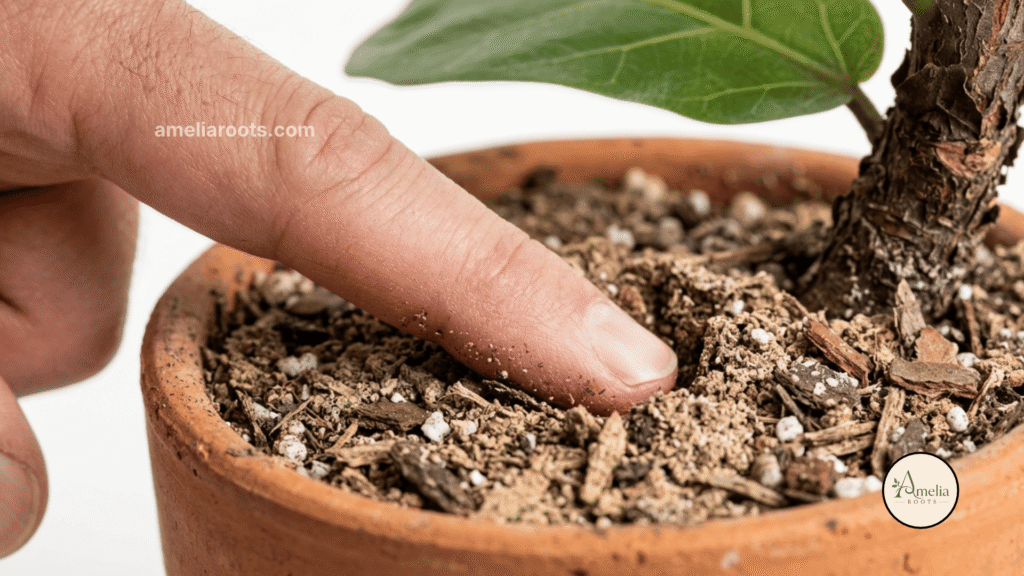
You’ve probably seen “top inch dry” in one guide and “top 3 inches” in another.
Both are correct, for different pots. The depth that matters grows with the pot.
| Pot Width | Soil Should Be Dry To |
|---|---|
| 4 to 6 inches | 1 inch |
| 8 to 10 inches | 2 inches |
| 12 inches or more | 3 to 4 inches |
Dry means loose and dusty. If it feels cool or sticks to your skin, it’s still moist.
Check 2: Skewer, for the deep soil
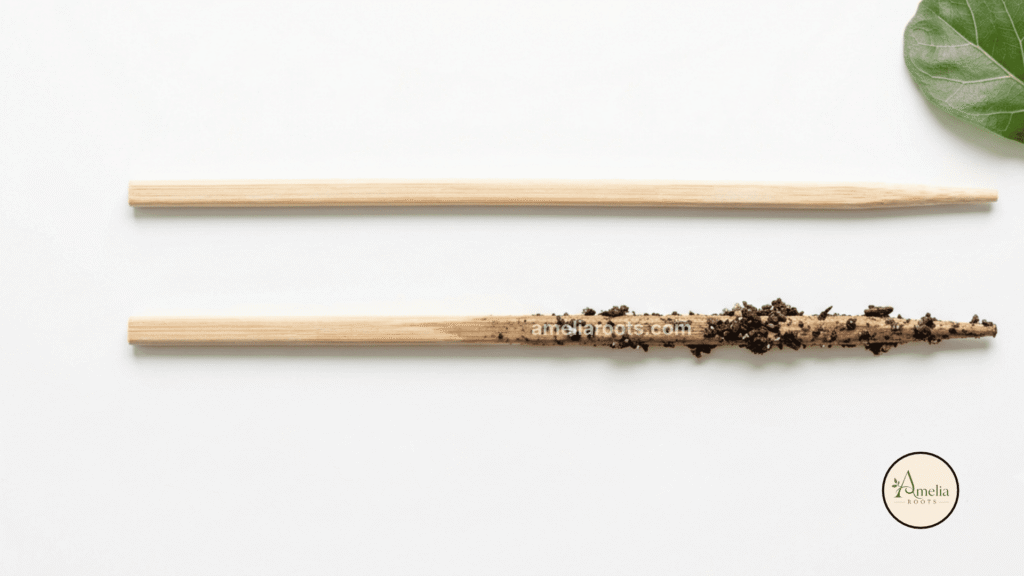
In a big planter, the top can be dust while the bottom is mud. Rot starts at the bottom.
Slide a plain wooden skewer about two-thirds of the way down. Count to ten and pull it out.
If it comes out clean and pale, the soil is dry. If it’s dark with soil clinging to it, wait three or four days.
Check 3: Lift
Tilt or lift the pot right after watering. Remember that weight.
A dry pot feels startlingly light. Within a month, your hands will know the difference.
A word on moisture meters
They help in deep pots. But cheap ones can read “dry” in damp soil.
I once watered on a false reading and got yellow leaves for it. Now the meter only breaks ties, and the skewer gets the final say.
Find Your Fig’s Number: The Dry-Down Test
This is the part I wish someone had shown me in year one.
Every fig has a number: the days it takes your pot, in your room, to go from soaked to dry. You can find it with one watering cycle.
Step 1. Water thoroughly. Call it Day 0 and write the date down.
Step 2. From Day 5, run the three checks every two or three days.
Step 3. The first day all three say “dry” is your number.
Step 4. Water again, and the cycle restarts.
Say your number is 12. From now on, don’t touch the watering can before Day 9. Start checking then.
That written log matters more than it sounds. Memory drifts back toward “it’s been a while, I’ll just water.” If you want a ready-made place to track it, along with the rest of your plant care, grab the Indoor Plants Care Kit — it’s free.
One habit keeps the number honest. I re-run the test twice a year, when the clocks change in March and November.
Those two weekends mark the light shifting, and your fig’s thirst shifts with it.
What Moves Your Number
Costa Farms, one of the country’s largest houseplant growers, offers a useful baseline. A 6-inch pot needs water about every 7 days in spring and summer, a 10-inch pot about every 2 weeks, and those stretch to roughly 2 and 3 weeks in fall and winter. (Costa Farms)
Your own number will drift from there.
| If This Changes | Your Number Gets |
|---|---|
| Plant moves closer to a window | Shorter |
| Furnace or AC runs constantly | Shorter |
| Switch to terracotta | Shorter |
| Winter, shorter days | Longer |
| Repotted into a bigger pot | Longer |
| Dense, peat-heavy soil | Longer |
Two traps catch people every year.
Winter heat fools the finger test. Forced air dries the top inch fast while the plant barely drinks in the weak light. From December to February, I rely on the skewer.
Fresh soil holds water. After repotting, there are no roots in the new mix to pull moisture out. Check deeper for the first two months.
When the Soil Says Yes: How to Water
- Lift the nursery pot out of its decorative pot, or move the plant to a sink or tub.
- Pour slowly across the whole surface.
- Keep going until water runs steadily from the drainage holes.
- Let it drain for 10 to 15 minutes.
- Empty the saucer or cover pot completely.
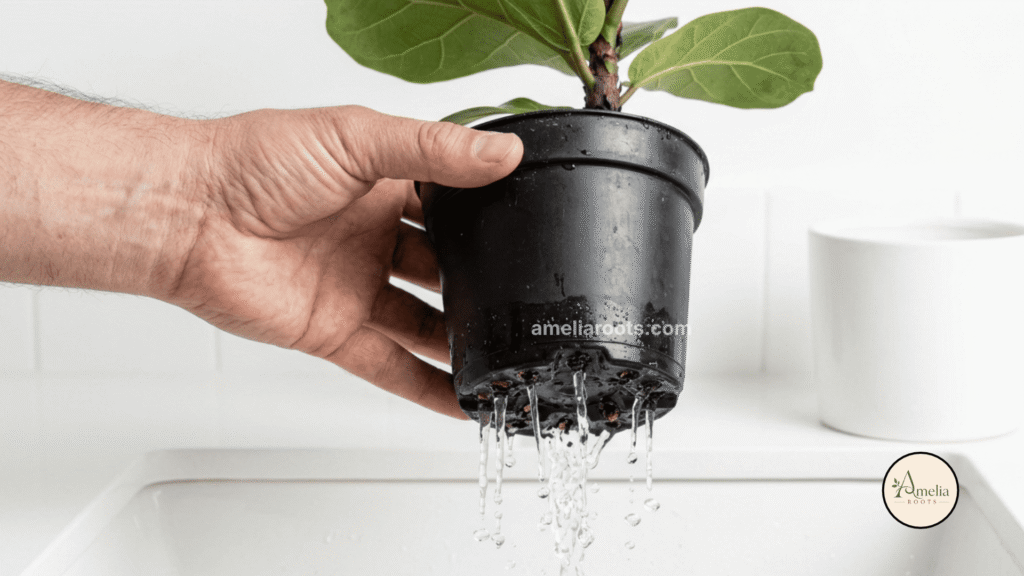
Step 5 is the one people skip.
The University of California’s master gardeners give the same warning: a pot left sitting in its drained water will develop root rot. (UC ANR) ucanr
I’ve tipped a full cup of hidden water out of a cover pot I was sure was empty.
Why “one cup a week” fails: a measured pour wets the top few inches and never reaches the lower roots. The top stays damp enough for fungus gnats while the roots underneath stay dry.
A pot with no drainage hole makes all of this guesswork, so fix that first.
Read the Soil First, Then the Leaves
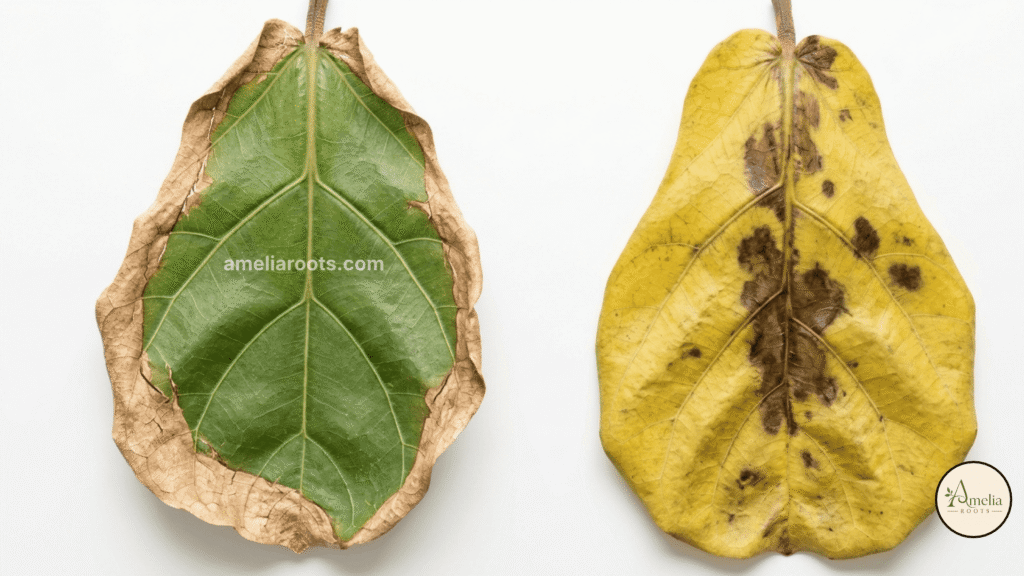
A drooping fig looks thirsty. Sometimes it is.
Other times its roots are rotting and can’t drink the water that’s already there.
| Sign | Underwatered | Overwatered |
|---|---|---|
| Leaf edges | Brown and crisp | Yellowing, dark blotches |
| Leaf feel | Dry, curled | Soft, limp |
| Soil | Dry, pulling from the pot edge | Wet, musty |
| Pot weight | Very light | Heavy for days |
| Leaf drop | Anywhere | Lower leaves first |
Two lines settle most cases:
- Droop + dry soil: water today.
- Droop + wet soil: put the can down and check the roots.
If the fig is drooping in healthy, moist soil, look at the light. It’s usually too far from the window.
If You’ve Already Overwatered
Don’t “water a little” to make up for it.
- Stop watering. Move the plant to brighter light.
- If the soil is still wet after 10 days, slide the root ball out.
- Firm, pale roots are healthy. Dark, mushy, sour-smelling roots are rotten.
- Trim the rot with clean scissors.
- Repot in fresh, fast-draining mix, in a pot with holes.
- Wait a week, then go back to the soil checks.
You’ll likely lose a few leaves. A fig with firm roots recovers.
Quick Questions
Should I water my fiddle-leaf fig every week?
Check it weekly. Water only when the soil is dry at the right depth. For many plants that’s less often than weekly.
How much water does it need?
Enough to soak the whole root ball until water runs out the bottom. Skip the measuring cup.
How often in winter?
Usually every 2 to 4 weeks, sometimes longer in low light. Let the skewer decide.
Does misting count as watering?
No. Misting wets the leaves for a few minutes and does nothing for the roots.
Are self-watering pots a good idea?
I avoid them for this plant. They keep soil evenly moist, and a fiddle-leaf fig needs to dry out between drinks.
Do This Today
Push a finger into the soil. Slide a skewer in. Lift the pot.
Then write down the date and what you found.
That one note is Day 0 of knowing your plant better than any care tag does.

Content writer and SEO specialist with 3+ years of experience in research-driven digital content. At Amelia Roots, he turns carefully researched indoor gardening information into clear, practical guidance for houseplant owners and home gardeners. His work combines content research, search intent, and reader-focused writing with the site's editorial and subject-matter review process.