
A black leaf on a peace lily is old news.
By the time you see it, the damage down in the pot happened a week or two ago. The leaf is the receipt, not the purchase.
That’s why the usual reflexes backfire. People water the droopy plant, mist the leaves, or snip off everything dark. Meanwhile the roots, which are the real problem, keep getting worse.
I’ve slid peace lilies out of pots where the top inch felt dry and the bottom was soup. After 2 years of growing and rescuing them, I read black leaves differently: as a clue about the roots, the window behind the plant, or the water coming out of the tap.
This guide shows you how to read the black on your plant, match it to its cause, and fix it in the right order. It covers black leaves, tips and spots. Flowers and yellowing get a quick mention, nothing more.
Short answer: Black leaves most often mean the roots are sitting in soil that stays too wet. Stop watering until the top inch dries, empty the saucer, and check the roots. Move the plant away from cold glass and vents. Cut off only the leaves that are fully black.
Read the Black Before You Touch Anything
Where the black sits, and how it feels, tells you more than the color does.
| Where it is | How it feels | Usual cause |
|---|---|---|
| Whole leaves, limp, soil wet or sour | Soft, mushy | Wet roots, root rot |
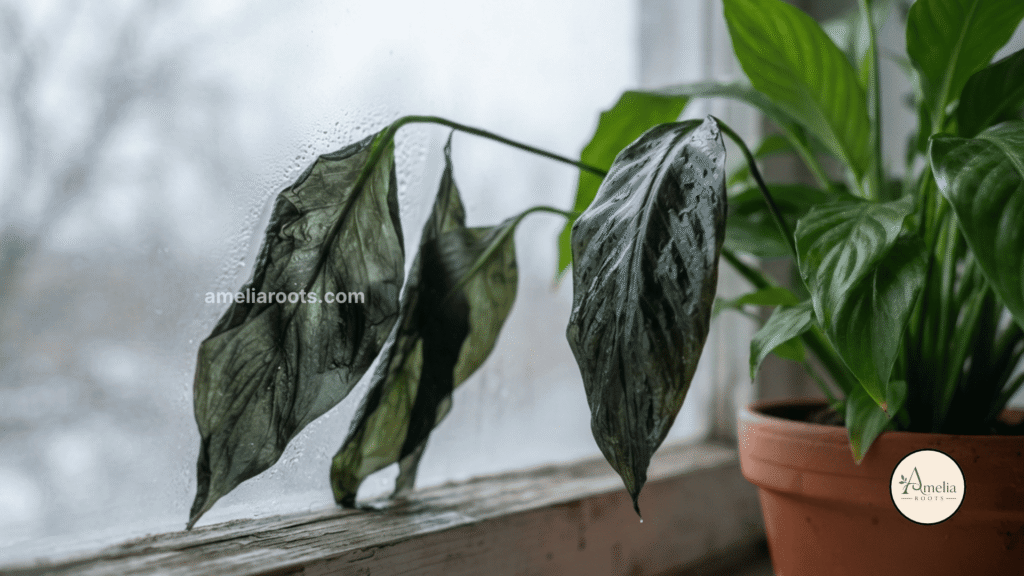
| Only leaves touching glass or facing a vent | Limp, water-soaked | Cold damage |
| Tips and edges only | Dry, crisp | Salts, fluoride, dry air |
| Spots with a yellow ring | Spreads over days | Leaf spot disease |
| Pale tan patches that darken | Papery | Sun scorch |
| Just the white flower | Dries out | Normal bloom aging |
My shortcut: mushy points to the roots or the cold. Crispy points to salts, minerals or dry air.
Grab the Indoor Plants Care Kit — it’s free.
Whichever row you landed on, the next few weeks come down to small adjustments in water, light and placement. That’s where most rescues fall apart, because nobody remembers what they changed or when. The Indoor Plants Care Kit gives you a plan to work from, so you’re not guessing at each step.
Wet Roots: The Cause Behind Most Black Leaves
Roots breathe. Saturated soil pushes the air out, and the fine roots begin to suffocate and rot.
Rotting roots can’t carry water upward. So the leaf dies from the edges inward, soft and black.
Here’s the cruel part. The plant droops, which looks exactly like thirst. So the owner waters again.
The 3-touch test
It takes one minute. Do it before anything else.
- Lift. A pot that still feels heavy days after watering is holding water the plant can’t use.
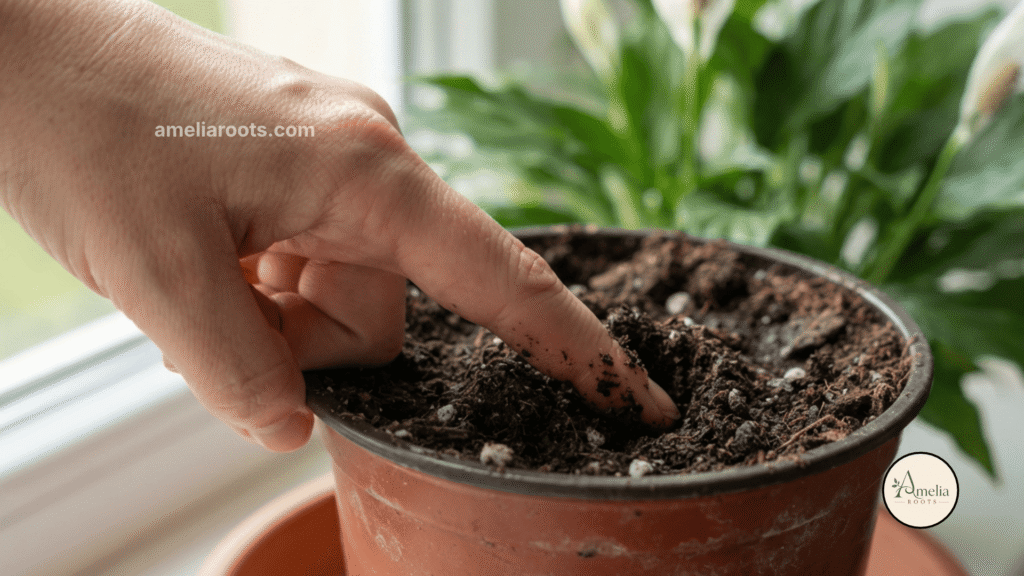
- Press. Push a finger down to the second knuckle. Cold, wet soil there is a problem, even if the surface looks dry.
- Smell. Sour or swampy means rot has started. Healthy mix smells like plain earth.
Two plants, one symptom
I’ve seen identical black leaves come from opposite mistakes.
Plant A sat in a pot twice as wide as its roots and got “just a little” water every other day. The roots were mush.
Plant B was in the right pot, went bone dry, then got flooded. Black tips, but the roots were still firm.
Plant A needed trimming and a smaller pot. Plant B only needed steadier watering. That’s why I check the roots before changing anything.
Don’t overcorrect, though. Extension horticulturists point out that peace lilies like to stay a bit more evenly moist than most houseplants, not dried out deep in the pot (Ask Extension). Let the top inch dry, not the whole pot.
How I water now
I water when the top inch is dry and the pot feels lighter. Then I water thoroughly, let it drain, and empty the saucer.
Small daily sips keep the top wet and the bottom stale.
Watch for this: a nursery pot sitting inside a decorative pot with no drainage holes. Water pools at the bottom where you can’t see it. Lift the inner pot out and look.
What the roots are telling you
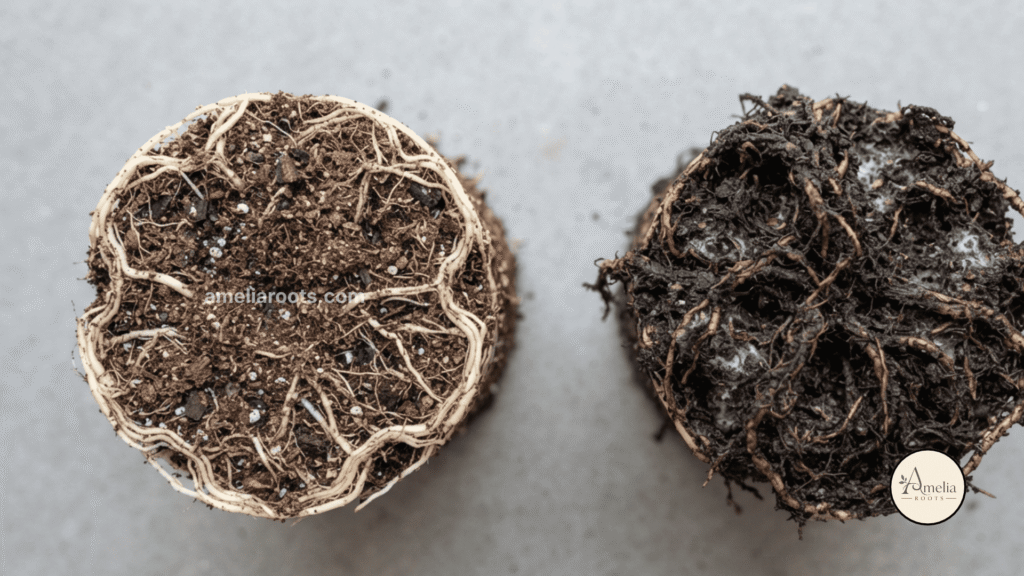
Slide the plant out and compare.
| Healthy | Rotting | |
|---|---|---|
| Color | White to cream | Brown or black |
| Feel | Firm | Mushy, slips apart |
| Smell | Earthy | Sour |
If the roots look healthy, leave the pot alone. Fix your watering and drainage instead. Repotting a stressed plant for no reason adds stress.
Cold: The Glass Test
Peace lilies are tropical, and cold hurts them faster than most people expect.
University of Florida researchers found that five days at 38°F or 45°F caused injury ranging from dead patches to total plant loss. At 50°F the damage was mostly invisible, showing up as slowed growth (UF/IFAS Extension).
Clemson’s Home & Garden Information Center advises avoiding anything below 60°F (Clemson HGIC).
Indoors, the trouble spots are easy to miss. A cold windowsill. A draft under an exterior door. An AC vent aimed at the leaves.
Try the glass test. If the black is only on leaves touching the window, or only on the side facing a vent, suspect cold. Move the plant and keep the soil on the drier side while it recovers.
Tips Only: Salts, Fluoride and Dry Air
When only the tips and edges turn black or dark brown and feel crisp, look at what goes into the pot.

Peace lilies aren’t salt tolerant, according to UF/IFAS. NC State Extension says over-fertilizing and salt buildup can burn both leaf tips and roots (NC State Plant Toolbox).
The University of Missouri also lists fluoride in tap water as a common cause of tip burn on houseplants, with a peace lily as its example (Missouri IPM).
A white crust on the soil or pot rim is the giveaway for salt buildup. Here’s what I do:
- Flush the pot. Run water through it for a couple of minutes, let it drain fully, and repeat once.
- Switch the water. Distilled or rainwater rules out fluoride and chlorine.
- Stop feeding. Fertilizer on a struggling plant just adds salt to injured roots. I learned that the hard way.
- Skip the misting. It adds almost no humidity and keeps leaves wet. A humidifier nearby does the real work in dry, heated rooms.
The Look-Alikes
A few things look alarming but aren’t the same problem.
- Black spots with a yellow ring. Likely leaf spot disease, which spreads when water sits on the foliage. Remove those leaves, water the soil only, and give the plant airflow. Use a houseplant-labeled fungicide only if it keeps spreading, and follow the label.
- Pale tan patches that darken. Sunburn, usually after a move into direct afternoon sun. Bright, indirect light fixes it.
- Only the white flower going dark. Normal bloom aging. Cut the stalk at the base.
- One old outer leaf. Normal too. Several leaves at once, or new leaves coming in black, is not.
The Rescue Plan, in Order
- Stop watering if the soil is wet, and empty the saucer.
- Move the plant somewhere warm (above 60°F), bright and out of drafts.
- Check the roots using the table above.
- If they’re rotting, trim every black, mushy root with clean scissors. Repot in fresh, airy mix, in a pot with drainage holes that’s only slightly roomier than the root ball.
- Cut fully black leaves at the base. Leave leaves with only dark tips alone.
- Skip fertilizer. Water again only when the top inch is dry.
If the roots were firm, skip steps 3 and 4. A healthy plant doesn’t need a new pot.
Quick safety note: NC State Extension warns that peace lily leaves can be poisonous if eaten (NC State Plant Toolbox). Bin your trimmings where cats, dogs and kids can’t reach them.
Will It Come Back?
Judge by the crown and the new growth, not the old leaves. Black leaves never turn green again.
| What you see | What it means |
|---|---|
| Firm crown, stems still standing | Good odds |
| A few white roots left | It can rebuild |
| A new green spear unfurling | Recovery has started |
| Mushy crown, almost no healthy roots | Poor odds. Try dividing off any firm piece that has its own roots |

In my experience, a plant with a firm crown shows new growth within a few weeks. Some stay small for months after losing roots. That’s normal.
Mistakes I’d Skip (Three Were Mine)
- Watering on a calendar instead of by feel
- Feeding a plant that’s already struggling
- Repotting into a much bigger pot “for room”
- Misting to fix crisp tips
- Changing five things at once, so you never learn what worked
My rule now: one change, then wait a week.
FAQs
Should I cut off black peace lily leaves?
Yes, if the whole leaf is black, cut it at the base. If only the tip is dark, trimming is cosmetic. Keep healthy leaves, because they help the plant recover.
Can a peace lily recover from root rot?
Often, if the crown is firm and some healthy roots remain. Trim the rot, repot in fresh mix, and water only when the top inch dries.
Why are only the tips black?
Usually salts, fluoride or dry air. Flush the pot, try distilled or rainwater, and stop fertilizing.
Why is the flower turning black?
Blooms age from white to green to brown or black. It’s normal. Cut the stalk at the base.
How often should I water a peace lily?
There’s no fixed number. Water when the top inch is dry and the pot feels lighter, then drain fully.
What to Do Tonight
Run the 3-touch test. Check where the black sits. Change one thing.
Then look again in a week. If the new growth comes in green, you read it right.

Content writer and SEO specialist with 3+ years of experience in research-driven digital content. At Amelia Roots, he turns carefully researched indoor gardening information into clear, practical guidance for houseplant owners and home gardeners. His work combines content research, search intent, and reader-focused writing with the site's editorial and subject-matter review process.